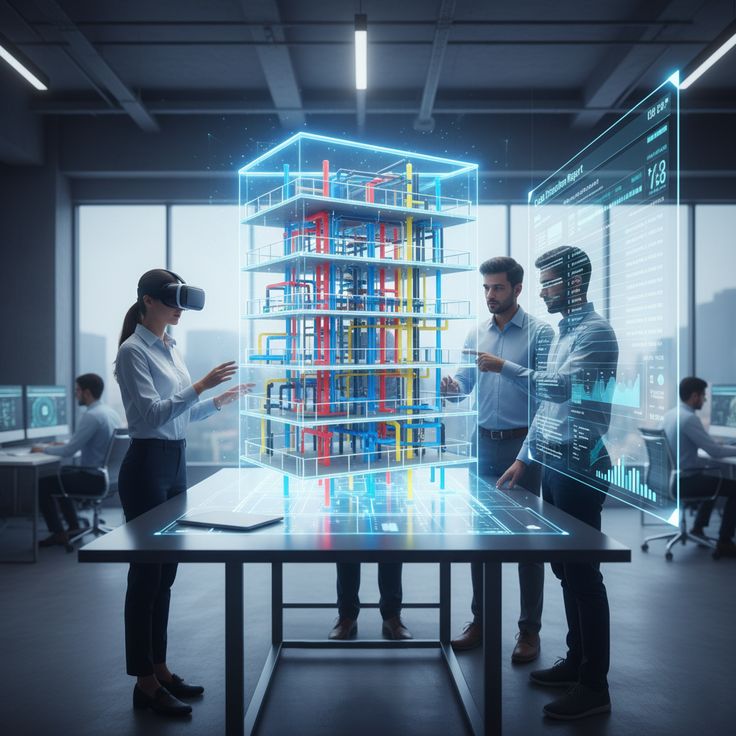
Construction has traditionally been one of the slowest industries to embrace new technologies. However, that is rapidly changing. By 2026, the integration of Artificial Intelligence (AI), Building Information Modeling (BIM), and Digital Twins will radically change the design, construction, and operation of buildings and infrastructures.
This is not some distant future but the present. Airports, metros, data centers, and even smart city ventures are already harnessing these technologies to accomplish their projects quicker, safer, and smarter.
We can deconstruct the work of these three tools individually and the synergy between them to understand why they are setting the new bar for the construction industry.
Understanding the Basics: BIM, Digital Twins, and AI
Before we talk about their impact, it’s helpful to understand what each one actually does.
BIM extends beyond mere 3D models. It is basically a digital replica of a building or infrastructure, loaded with data, which later enables teams to work together more effectively. Thanks to BIM, project teams can work more intelligently, minimize mistakes, and base their decisions on trustworthy data rather than assumptions.
What Is a Digital Twin?
Consider a Digital Twin as the “living” version of a building. If BIM is a highly detailed blueprint, then a Digital Twin is in contact with real time data coming from the sensors, equipment, and systems. It gives you the capability of seeing the operation in the building at any given time, even after it has been constructed.
How AI Fits In
AI analyzes an extremely large amount of data and detects patterns which might go unnoticed by humans. Regarding BIM and Digital Twins, AI can:
Predict issues even before they ariseOptimize schedules and resource useImprove safety and efficiencyHelp teams make smarter decisions throughout the projectIn essence, AI is transforming data into actionable intelligence thus, making the construction significantly more proactive than reactive.
Why This Combination Is a Game Changer
Each of BIM, Digital Twins, and AI is a powerful tool on its own. Together, however, they totally revolutionize decision making in construction.
Rather than allowing problems to happen first and then fixing them, the teams now get to foresee and prevent them.
Here’s an easy analogy to help you understand:
BIM
shows the design
Digital Twin shows the real, time situation
AI
makes a forecast of the next events
The combination of these three is changing the way projects are delivered, operated, and maintained.
How It Impacts Projects Across the Lifecycle
1.Making more intelligent design decisions
Artificial intelligence tools have the capability of analyzing a multitude of design choices and suggesting the best layouts, strategies for energy conservation, and coordination without clashes. Designers are not solely dependent on their experience anymore as they can now make data, supported decisions that result in time and cost savings.
2. Faster and Safer Construction
During construction, when AI is combined with BIM data, it helps:
Predict schedule delaysIdentify high, risk activitiesOptimize workflow and sequencingReduce errors and rework on siteIts not just a matter of saving money the main benefit is keeping workers safer.
3. Better Cost Management
By integrating cost and scheduling data into BIM models, AI can:
Forecast budget overrunsCompare planned and actual costsSuggest cost, effective optionsEnhance procurement and resource planningThis kind of help is most beneficial for major, complicated infrastructure projects.
4. Smarter Operations with Digital Twins
Digital Twins come into play after the construction of the building. They are linked with sensors and building systems, thus allowing the team to:
Track equipment and asset performanceAnticipate maintenance activitiesDecrease downtimeIncrease the lifespan of the building or assetFacility managers are capable of preempting failures instead of reacting to them.
Why Companies Are Adopting These Technologies Quickly
By 2026, companies and governments will be moving at a fast pace as: Projects are becoming more and more complex Budgets and timelines are tighter There are increasing demands for sustainability and energy efficiency The performance of buildings over time is very important In fact, airports, metro systems, hospitals, and smart city projects are at the forefront of this movement since the mistakes being made are too costly to be disregarded.
New Career Opportunities in Construction
These changes in technology operation are giving birth to some roles that couldn’t be imagined before:
Building Information Modeling (BIM) Managers morphing into Digital Engineering Managers Coordinators turning into Information Managers Facility Managers changing into Digital Asset Managers Engineers heading towards Construction Technologist rolesEmployees who know how to handle BIM and data and who have the ability to think strategically are in demand at a record level.
Skills Professionals Need to Stay Relevant
Technical skills are just the beginning.
Technical skill
Advanced BIM workflowsUnderstanding Digital Twin concepts4D & 5D BIM integrationManaging and analyzing data effectively
Strategic skills
Planning and implementing efficient processesCoordinating between teamsMaking decisions based on dataLeading projects and teamsThe ones with tech savvy plus a good strategy are those who will be at the helm of the industry.
Is This the Future of Construction?
Absolutely, BIM, AI, and Digital Twins are deeply changing the way smart buildings are designed, constructed, and operated.
By 2030:
All projects will use BIM as a standardAsset management will be done with Digital TwinsAI will be helping in the majority of planning and operational decision, makingConstruction is moving away from being a manual, reactive industry to becoming a data driven, predictive, and smart one.
Final Thoughts
AI, BIM, and Digital Twins are not merely popular words. They are revolutionizing the construction industry at its core.
If you:
Keep learning and upgrading your skills regularly
Think of workflows, rather than just tools
Take advantage of data to make your decisions more efficient
you will be the generation that constructs smarter, safer, and more efficient infrastructure.
Construction is no longer simply about concrete and steelit is now a matter of data, intelligence, and foresight. And this change is only at the beginning.