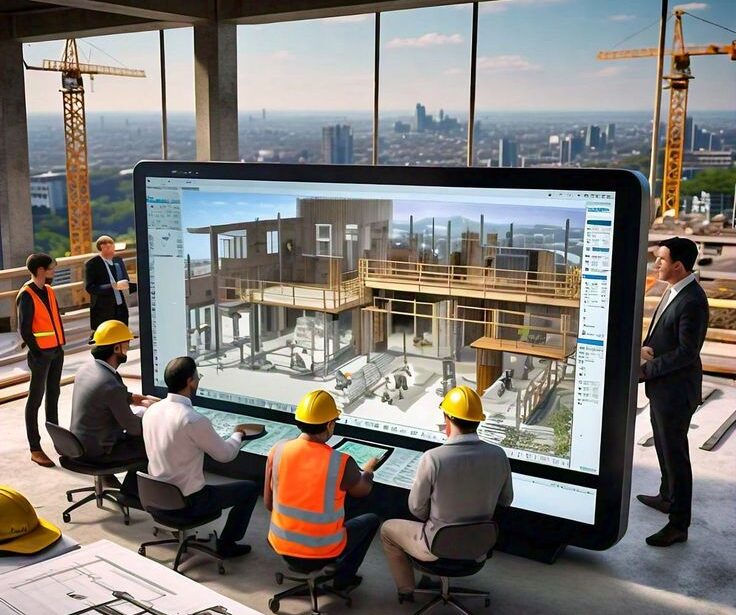
A New Digital Era for Civil Engineers
The world of construction is going by very rapidly, it is almost indescribable. New technology, smart tools, and digital systems are being used instead of old manual ways. And BIM – Building Information Modeling – is the thing that is changing the whole construction industry.
For civil engineers, BIM is no longer a concept “nice to know”.
By 2025, it has become a necessity of knowledge if you want to advance your career, have a better pick of work, and keep your place in the industry.
This blog uses simple language to clarify the necessity of BIM management, how it supports the work of civil engineers, and the reason why mastering it at this point of time can be a complete turn of your career.
Why BIM Has Become Essential in 2025-26
BIM is not just an advanced software; it is a comprehensive digital strategy for planning, designing, constructing, and managing buildings and infrastructure. A platform that enables the visualization, coordination, and analysis of every aspect of a project before the actual site visit is what a civil engineer needs today. Building Information Modeling (BIM) achieves this by producing an intelligent digital model that, in one place, combines structure, materials, cost, scheduling, performance analysis, and other aspects.
As a result of governments mandating BIM and engineering companies adopting digital-first workflows, the need for civil engineers skilled in BIM has never been greater. When the scale and complexity of infrastructure projects are growing, BIM has become the most effective and accurate method of uniting the design and construction teams.

How BIM Transforms Real Civil Engineering Workflows
One of the main features of BIM that make it revolutionary is the capability to remove those unknowns that usually cause delay and rework. For example, a mismatch between architectural, structural, and MEP drawings has traditionally led to expensive clashes that were only figured out during construction. With BIM, the engineers can see the entire project in a single 3D environment which helps them to find conflicts at an early stage. This, in turn, leads to fewer errors, higher precision, and better performance on the site.
Engineers are given the opportunity to investigate the structural system, examine the consumption of materials, measure the effects of the environment, and get familiar with the total performance of the building way before the construction process has started. The transparency that BIM offers to the decision-makers makes their decisions more logical, easier to anticipate, and more in compliance with the challenges of the real world.
BIM and the Rise of Smart Infrastructure
As urban areas transform into interconnected digital ecosystems, their respective infrastructures will have to be smarter, energy-efficient, and responsive. Building Information Modeling (BIM) is instrumental in the transition towards smart city conception. It is a tool that engineers use to make the design of roads, bridges, metros, airports, and public facilities more accurate and sustainable.
Given that climate performance and environmental impact are still the most important factors, engineers through the use of BIM are able to measure energy efficiency, carbon emissions, water consumption, material waste, and life-cycle cost, to name a few, all from one model.
The emergence of digital twin technology in 2025 means that BIM models no longer relate only to construction but are also used for performance monitoring and maintenance prediction. This is resulting in great benefits over time for the engineers as well as asset owners and hence BIM is becoming a must-have tool for infrastructure capable of withstanding the future.
Career Growth and Global Opportunities Through BIM
It has been noted that the job market for the last few years has changed radically, and those civil engineers who are trained in BIM are now leading in terms of professional opportunities. Companies all over the world are recruiting BIM engineers, BIM coordinators, BIM managers, and VDC specialists at a much quicker rate than those who are engaged in traditional CAD-based roles.
One who is well-versed in BIM not only gets access to better positions and higher remunerations but is also exposed to the opportunity of working with multinational construction firms. The likes of the UAE, UK, USA, Canada, and Singapore have already enforced the use of BIM as a prerequisite for large government projects, hence making BIM a strong launching pad for engineers who are willing to work in foreign countries. Graduates who BIM-trained during their studies are usually the first to get jobs and are more adept at managing complicated projects.
How BIM Makes Civil Engineering Work Easier
After the career advantages, BIM is a tool that can be used to simplify the everyday engineering tasks done by the traditional tools. When a modification is done to a BIM model, it could be in reinforcement details, beam sizes, or column placement, the whole model changes automatically. Hence, the repetitive drafting work is removed and the possibility of errors due to manual updates is reduced. Architects, engineers, and contractors communicate more effectively as a result of working on the same digital model. Besides that, BIM is a great tool for civil engineers when working on large-scale infrastructure projects that require understanding the interrelation of different building systems.
Instead of handling layers of drawings, engineers can now explore virtual models to get a detailed understanding of what they are constructing. It is a process that brings confidence, clarity, and accuracy to the whole workflow.
Why 2025-26 Is the Perfect Time to Learn BIM
As the construction industry is becoming more and more digital, 2025 may well be the turning point for civil engineers to adopt BIM. A few years from now, no company will consider BIM as a skill to be highly advanced—it is simply becoming a fundamental requirement. Staff will be those engineers who, when faced with the choice, decide not to go down the path of automated design, cloud collaboration, and real-time project monitoring. Hence, as environmentally conscious standards, project intricacies, and techno-friendly integration trends keep on rising, BIM will be the main instrument through which construction innovations will be possible. Mastering BIM today is not only a step toward job security, but it is also a way of keeping in touch with the industry which changes at a fast pace.
Conclusion
BIM is fundamentally changing how civil engineers create, plan, and oversee projects. It gives them more precise visualization, reliable data, less number of errors, better collaboration, and more intelligent project planning. With the global rise of infrastructure needs, BIM is turning into the base of environmentally friendly and resource-efficient construction. Regardless of whether you are a student, a novice, or an experienced civil engineer, acquiring BIM skills in 2025 is probably the smartest move you can make for your career. In addition to allowing you to contribute to the development of sleek, efficient, and future-ready infrastructure, it also facilitates your transition to new roles, better opportunities, and international pathways. Civil engineers equipped with the knowledge of BIM will be the leaders of the construction industry, the next generation.