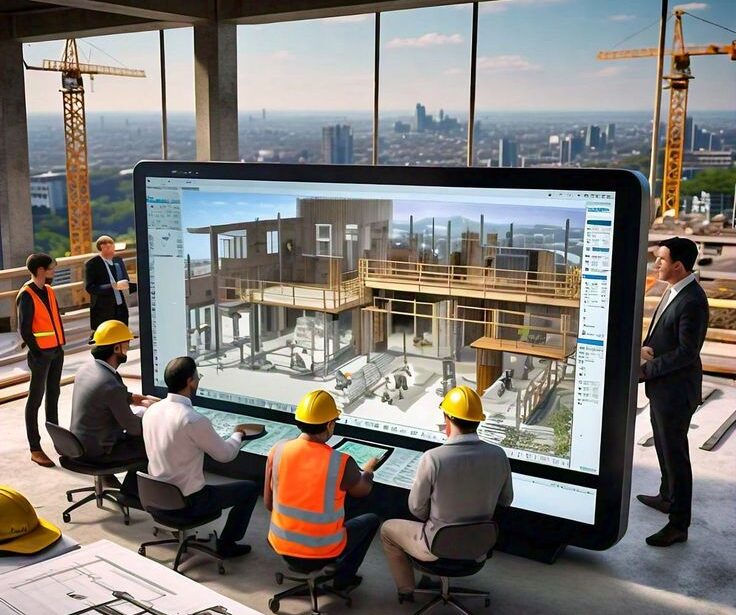
If you happen to be a civil engineer, whose mind is occupied with the question “Is BIM still a viable career in 2026?” you might as well know that you are not the only one thinking this way. This very question is being asked by engineers, architects, and construction graduates in thousands every year: “Is BIM worth learning? Is the industry still growing? Will BIM jobs be stable in the future?”
The short answer? BIM is not only a good career but it is becoming one of the strongest, most future-proof paths in civil engineering.
However, the long answer is much more intriguing because it deals with the real reasons no one is talking about why the number of BIM roles is increasing at a much faster rate than that of traditional civil engineering jobs. We, humans, often fail to understand complex issues but I would still try to explain it in a simplistic, life-related manner.
Why BIM Careers Are Growing in 2026 (Even Faster Than Before)
By the year 2026, the digital transformation of the AEC industry has become a necessity rather than an option. The new demand for faster, accurate, and efficient construction workflows is being pushed by Governments, private firms, and global contractors, and BIM is the technology that enables this change.
Several countries such as the UAE, the UK, Singapore, Australia, India, and the US have escalated BIM mandates in their public projects. The fact is quite straightforward: More BIM adoption = More BIM jobs = More demand for BIM-skilled professionals.
Construction companies are not just asking for BIM any longer—they are relying on it.
This is the main reason why roles such as BIM Modeler, BIM Coordinator, BIM Engineer, BIM Manager, Scan-to-BIM Specialist, and Digital Twin Specialist are turning into the most significant positions in every large-scale project.

BIM Career Demand in 2026: What the Market Honestly Looks Like
Here’s what’s really going on behind the scenes:
1. Traditional civil engineering roles are overcrowded
The ones who pick up civil engineering for their study are the students, but the job market for civil engineers remains stagnant. This situation brings about the competition for jobs, salaries get lower, and the number of roles become limited.
2. BIM roles offer quicker growth
BIM roles are sometimes 20-60% more lucrative than the conventional drafting or site engineering jobs as the work entails:
3D thinking
Use of digital tools
Coordination skills
Model-based planning
By 2026 the greatest hiring spike is seen in BIM Coordination and BIM Management positions as companies require employees who can facilitate communication between architecture, MEP, and structural teams.
3. Companies like engineers who have software + digital skills</strong>
A civil engineer familiar with the use of Revit, Navisworks, BIM 360, Synchro, Dynamo, or Clash Detection workflows immediately captures the attention.
These skills make an engineer more indispensable as they lessen the project errors, eliminate the rework, and facilitate the execution.
4. BIM is now very much intertwined with
By 2026, BIM is not a separate field but is integrated with:
Digital twins
AI-based model checking
4D and 5D simulations
Reality capture (laser scanning, drones)
IoT-based asset monitoring
This implies that BIM workers are dealing with future technologies long before the traditional engineering workflows.
Is BIM a Stable Career in 2026? The Honest Reality
Stability is essentially derived from one factor: necessity. BIM is, in fact, a necessity in construction.
Small and medium-sized enterprises are even investing in BIM teams because:
Clients demand clash-free, coordinated designs
Contractors want precise schedules and cost plans
Government tenders require digital submissions
Execution teams need model-based workflows
This transition is a guarantee of stability for BIM professionals in the future.
If you are concerned that BIM might “die” or “get replaced,” actually the reverse is true—AI is strengthening BIM, not weakening it.
AI tools are there to help with automation, but the industry still requires people who have a deep understanding of engineering logic, design intent, and coordination.

What BIM Career Paths Look Like for Civil Engineers
BIM is not just one job anymore, it is a whole career ecosystem.
Civil engineers have the potential to evolve into such positions as:
Structural BIM Modeler BIM Coordinator BIM Engineer BIM Execution Planner BIM Lead BIM Manager Digital Construction Manager Digital Twin Specialist VDC Engineer Scan-to-BIM Expert
Such a layered progression allows engineers to begin with a small role and eventually develop into leadership positions.
The salary increases are also quite substantial. The salary of a BIM modeler may be quite modest at the beginning, but a BIM Manager or BIM Lead can make very high salaries, especially in the case of international projects.
Do You Really Need Advanced Skills to Start?
The reality is: If you want to make a career in BIM, you don’t have to be a software genius.
Almost the entire BIM staff initially comes from:
Revit (the necessary foundational layer)
Navisworks (for clash detection)
Somewhat familiar with the drawings and construction
The market demands the above abilities more than technological skills. The capability to visualize in 3D, grasp the concepts of building systems, and act as a liaison between different groups is what counts most.
New graduates can also get a BIM position by concentrating on tool usage and workflow learning.
Why Civil Engineers Are Switching from Site Work to BIM Roles
Most of the today’s engineers are switching to BIM because:
Working on the ground can be heavy on the body
Income is usually kept at a low level
Development is slow and uncertain
It is difficult to maintain the balance between work and life
Jobs in the digital sector provide better comfort and flexibility
With BIM positions, engineers have the opportunity to carry on their technical knowledge in a more efficient, digital way while still being able to have an office-based career.
How AI is Shaping BIM Careers in 2026 (Without Replacing Engineers)
AI is helping to speed up BIM processes by automating some tasks such as:
clash detection suggestions model checking quantity extraction rule-based modelling However, AI is not able to take over the role of engineering thinking, decision-making, or design logic. Engineers using AI-assisted BIM tools will be the ones to gain higher value.
By 2026, enterprises will be on the hunt for BIM engineers with a dual understanding of software + engineering fundamentals.
Conclusion: Is BIM the Right Career Choice in 2026?
If you are a civil engineer wanting to have a career that would still be relevant in the long run, grow with you, and be of global significance, then BIM is definitely among your top choices in 2026.
The building industry is going through a digitization process, and BIM is at the forefront of this change. Organizations all over the world are on the lookout for professionals with BIM skills at a record pace, they are paying more attractive salaries, giving better work-life balance, and career stability for the long run is becoming more and more of a reality. While traditional engineering roles may remain unchanged, BIM roles will, nevertheless, keep changing, growing, and have a major influence in the sector
If you were to decide whether to learn BIM or not, deciding is as clear as day: Start right away. The future of civil engineering is digital—and BIM is at the center of it.