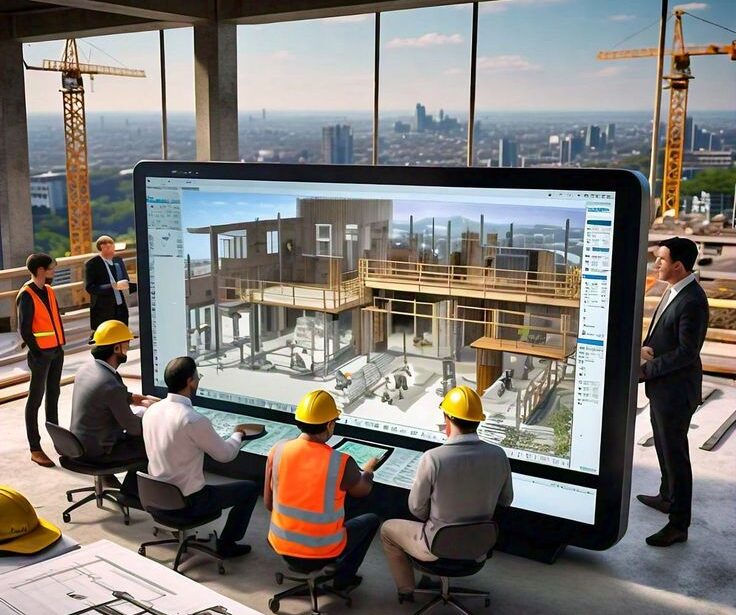
Compared to ten years ago, construction is a totally different thing today. Structures are more complicated, there are less days to complete the works, and customers demand perfect results. In such a circumstance, a tiny error in the design of a duct crossing a beam can result in a substantial delay and extra expenses being caused at the construction site.
That is the place where Clash Detection in BIM comes. It has become one of the most significant parts of the design and coordination process in 2025. The main idea is not to uncover the problems when building the structures but to find out the issues in the digital models and solve them before the site is ready.
If you are an architect, engineer, or a member of any construction team, it is not only handy but also necessary to know what clash detection is. This guide provides all the information in a simple, understandable manner.
What Is Clash Detection in BIM?
Think of it as if you are making a house. The architect puts the wall. The electrician wires the house. The plumber pipes the house.
What if it is that—without knowing—the pipe is in the same place as the electrical conduit?
It’s a clash.
BIM clash detection is all about resolving those conflicts inside the 3D digital model before the team arrives on the site. Instead of finding out the mistake after the materials are bought or the walls are built, the BIM model shows it at the very beginning, thus, saving time and money.
Those are the places where the conflicts normally arise between:
Architectural vs. Structural elements
Structural vs. MEP elements
MEP vs. MEP systems
Or even in the project schedule (4D clashes)
Comparing your planning with the real world, clash detection is that “reality check” of construction planning.

Why Clash Detection Matters in 2025-26 More Than Ever
The way construction operates is changing. The projects are grander. The MEP systems are complicated to a higher degree. The sustainability rules are getting stricter. And delays cost more and more.
It has become clash detection, which the industry cannot do without in 2025.
It really saves a lot of money
If you remove a clash from the design in a couple of minutes, you can hardly imagine it taking a few minutes.
Removal on the spot can, however, bring the whole project to a halt.
Clash detection makes sure that there are no:
Wasted materials
Systems that have been installed already, but redoing them
Design changes at the last minute
Unplanned rework
Moreover, it collaborates better
Architects, engineers, and contractors may not necessarily use the same approach when designing. So, what clash detection does is that it gathers all the models in one space where the interaction of the works can be seen by everyone.
The construction process is speeded up by it
As long as the design is neat and coordinated, the installation will be easy and anticipated. No more “stop work” situations when teams stumble upon the overlapped areas which had not been considered.
Additionally, it is a great help for prefabrication
The components to be prefabricated should have accurate measurements.
Clash detection is the one that guarantees that each and every dimension and clearance is right prior to the production of the parts.
Types of Clashes in BIM
1. Hard Clashes
These are the main, tangible issues.
Example:
A duct going through a beam.
A pipe going through a column.
These are the ones that have the power to bring a project to a halt instantly if they are not discovered early.
2. Soft Clashes
These refer to comfort, safety, or maintenance aspects.
Example:
An HVAC unit that doesn’t have enough space for servicing.
A fire panel that can’t be fully opened.
These do not physically collide but create operational issues.
3. Workflow or 4D Clashes
These are the issues related to time.
Example:
The schedule shows that electrical work will start before the walls are built.
4D clashes are the change of the sequences that pinpoint the errors that can be the cause of the timeline being disrupted.
How Clash Detection Happens
1. Integration of All Models
Separate architectural, structural, and MEP models are combined into a single federated model. Commonly used are such tools as Navisworks and Revizto.
2.Clash Rules Are Defined
The teams decide: <br> Elements to be checked <br> Required spacing <br> Priority of systems
Here the step prevents the false matches that are unnecessary.
3. The Software Performs Automated Clash Tests
The software reviews the whole model and creates the conflicts that can be found along with the screenshots and the exact locations.
4. Clashes Are Studied, and Categorized
Not all clashes are a crisis.
Teams classify them into: <br> Critical <br> Important <br> Minor <br> Acceptable
That helps people to deal with the amount of work.
5.Coordination Meetings Occur
Discussion of clashes and agreeing on solutions are the objectives of the meeting of all the architects, structural engineers, and MEP teams.
6.Model Updating
The teams reflect on their model changes as per the decisions made. <br> New editions are uploaded, checked, and confirmed.
7.Final Model Without Clashes
After all the rechecks and revisions, the model is good to go and will be used for the next stage of the project.
Tools That Power Clash Detection in 2025-26
The major arsenal of tools are:
Autodesk Navisworks Manage
Solibri Office
Revizto
BIMcollab
Revit Coordination Tools
Most tools today offer cloud coordination, issue tracking in real-time, and AI assistance.
What teams really feel is the impact of clash detection
Here is the truth of the matter: when clash detection is employed appropriately, these are the results that follow:
Projects get completed in less time
Designs become more precise
Stakeholders communicate more effectively
Less number of RFIs and change orders
Installation processes become safer
Higher quality standards
Better utilization of prefabrication
Enhanced mutual trust among teams
Challenges Teams Still Face
Even with BIM, clash detection is not completely accurate.
Some of the typical issues are:
Poor model accuracy
Different software formats
Big lists of clashes which make teams very difficult to carry on
Uneven BIM standards
Missing deadlines for model updates
These problems are mostly resolved through better planning and improved BIM execution processes.
The Future of Clash Detection: Smarter, Faster, More Automated
Year 2025-26 will be the starting point for a new generation of clash detection.
AI Predictions
Artificial intelligence tools are able to foresee conflicts even before the engineers propose the components.
Automated Fix Suggestions
In the near future, the smart software will be able to do more than just identifying conflicts – it will be able to provide the best solution to the problem.
VR & AR Clash Reviews
The team members have the chance to experience the building through virtual reality and get an instant report of the clashes happening there.
Digital Twins
Accurate building data from the real world will be linked to BIM models, enabling catching of the maintenance-related clashes as well.
The organization is turning into one that is more anticipative, more automated, and much more intelligent.
Conclusion
Clash detection has become an indispensable part of BIM and is probably one of the most significant factors in 2025 for successfully accomplishing a project. No matter what you are doing – designing a hospital, a high-rise, a commercial building, or a residential development- clash detection helps you avoid the costly surprises and gives you a smoother construction experience.
For architects, civil engineers, structural designers, and MEP professionals, knowing how to handle clash detection is not only a way of staying ahead of the competition, but it is also a fundamental project quality skill.
A clash-free model is a clash-free site. And in the construction world of today, that is the main thing that leads to faster delivery, better coordination, less stress, and more successful projects.