
Best BIM Projects in India and the World (2026): A Complete Guide
ntroduction: Why BIM Projects Matter More Than Ever in 2026
Building Information Modeling (BIM) has moved far past the “3D modeling tool” stage. Today, it’s the backbone of how the world’s most ambitious projects get built. Teams use it to design, coordinate, and deliver infrastructure, transportation, and architecture on time. And crucially, with fewer costly errors. This guide walks through the best BIM projects India 2026 has to offer, alongside the best BIM projects in the world, and breaks down exactly why they matter for your career.
BIM in infrastructure India has grown fast, and the government deserves much of the credit. Initiatives like the Smart Cities Mission and Digital India pushed the industry forward. As a result, project delays that once affected roughly 60% of Indian projects are now dropping. Meanwhile, the Indian BIM market keeps expanding at close to 17% annually, and top BIM companies India now compete on the global stage. Globally, the story looks similar. BIM has become the standard for anything genuinely complex. For example, engineers have used it to build bridges without a single 2D drawing and skyscrapers over 800 metres tall. Even Digital Twin construction — where a live digital model mirrors a physical building in real time — is quickly becoming the norm on major projects.
So why does this matter to you? If you’re an architect, civil engineer, or MEP professional, you’re probably wondering where the industry is headed. These Building Information Modeling case studies offer a clearer answer than any trend report. And if you’re deciding whether a BIM certification course is worth the investment, the projects below make the case better than any brochure could.
Part 1: Best BIM Projects in India (2026)
1. Delhi–Mumbai Expressway
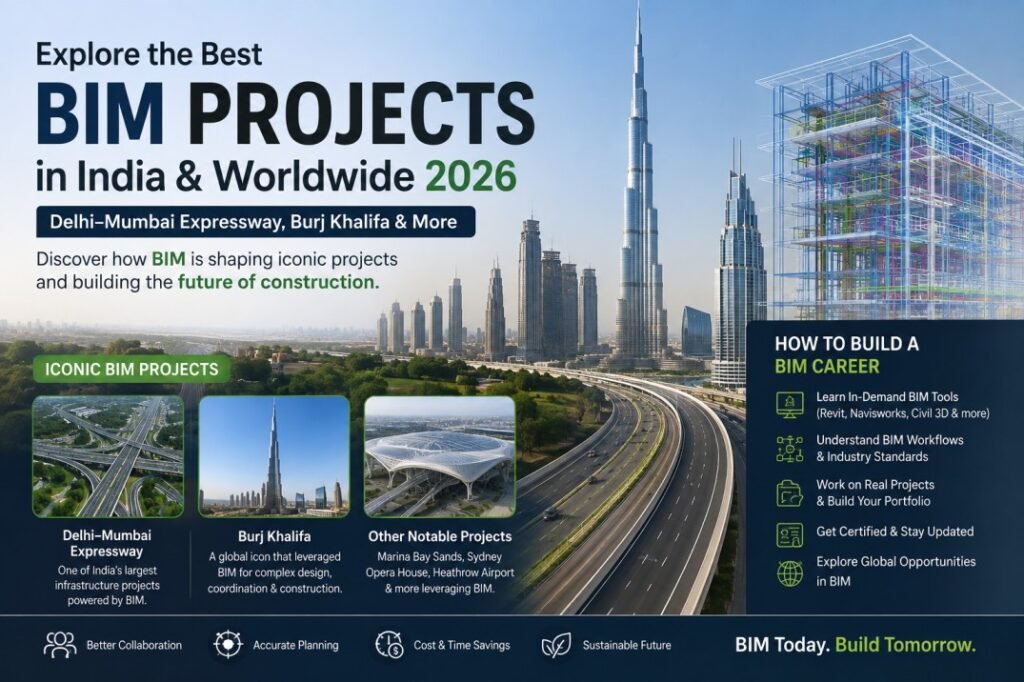
This 1,350-kilometre expressway is India’s most ambitious infrastructure project. It spans six states, and teams built it using 3D modeling, drone surveying, and cloud-based collaboration software. Once fully operational, the expressway will cut travel time between Delhi and Mumbai from roughly 24 hours to just 12. That’s a direct result of BIM-driven planning, clash detection, and coordination between multiple agencies — at a scale India hasn’t attempted before.
2. Nagpur Metro Rail Project
The Nagpur Metro uses BIM to build detailed 3D models of stations, tracks, and support systems. As a result, engineers can coordinate across disciplines and catch design conflicts early, before they become expensive on-site problems. In fact, a structured BIM workflow now helps teams manage both underground and elevated sections without the coordination headaches that plagued older metro builds.
3. Mumbai Metro Expansion
Mumbai’s ongoing metro expansion leans heavily on BIM MEP software — a great real-world example of BIM for MEP engineers in action. It handles the mechanical, electrical, and plumbing coordination across multiple lines. Additionally, teams use Autodesk BIM 360 to collaborate in real time, which has significantly cut down on rework and miscommunication between design and construction crews.
4. Chennai Metro Phase II
Chennai Metro Phase II uses 3D BIM models to visualize station layouts and optimize passenger flow. It also helps teams catch design clashes before they hit the construction site. Overall, it’s a textbook example of how BIM reduces both safety risk and budget overruns on large public transit projects.
5. The New Parliament Building, Delhi
Many consider the new Parliament building one of India’s flagship BIM case studies. Teams used BIM across every discipline — architectural, structural, and MEP — to coordinate a highly complex build. And they did it within a tight, very public timeline.
6. Personal Rapid Transit (PRT), Amritsar
Amritsar’s PRT system was a landmark early adopter project. It helped prove BIM’s value in Indian infrastructure well before the technology became mainstream. Consequently, it paved the way for the metro and expressway projects now setting the industry standard.
Part 2: Best BIM Projects Around the World (2026)
1. Shanghai Tower, China
Shanghai Tower ranks among the tallest buildings on Earth. Its twisting form and complex MEP systems would have been nearly impossible to coordinate without BIM. Today, it remains a reference case for how BIM enables both structural innovation and sustainable design at extreme scale — and its ongoing facility management now relies on Digital Twin construction principles to monitor performance in real time.
2. Helsinki Airport, Finland
Teams used BIM to manage the airport’s expansion. It also helped the owner, Finavia Corporation, evaluate the feasibility and ideal placement of solar panels. As a result, the project won the Public category award at the Tekla Global BIM Awards.
3. Randselva Bridge, Norway
This 600+ metre cantilever concrete bridge relied on BIM at every single stage of construction. Remarkably, teams built it without traditional drawings, using a model containing over 200,000 rebars and 250 post-tensioning cables. Because of this achievement, it won two separate Tekla Global BIM Awards, including Best Infrastructure Project.
4. One World Trade Center, USA
Few BIM projects carry the symbolic weight of One World Trade Center. Beyond its emotional significance, the project stands as a major coordination case study. It shows how BIM helped manage one of the most scrutinized rebuilds in modern construction history.
5. The Shard, London, UK
The Shard features 11,000 glass panels, and no two are exactly alike. Its floor plates also taper continuously from ground to tip. Together, these factors made it one of the most coordination-intensive projects Europe has ever seen. For instance, shifting one facade panel by half a degree affects the structural fixings, waterproofing, and curtain wall brackets floors below. That’s precisely the kind of cascading complexity BIM was built to manage.
6. Mercedes-Benz Stadium, USA
This stadium is famous for its retractable roof, which resembles a camera aperture. To plan and execute one of the most mechanically complex roof structures in modern sports architecture, the team relied heavily on BIM.
7. King Abdulaziz Center, Saudi Arabia
BIM coordinated the construction of this cultural landmark’s complex geometric steel roof structure. It also helped manage the integration of advanced audiovisual systems throughout the building.
8. Crossrail (Elizabeth Line), UK
Crossrail ranks among Europe’s most ambitious underground rail projects. Teams used BIM for all MEP design elements, which helped them coordinate complex systems across multiple underground stations spanning the length of London.
9. Burj Khalifa, UAE
The tallest building in the world required next-level MEP construction planning. Specifically, BIM helped teams manage everything from fire safety systems to air conditioning across a structure stretching over 800 metres high.
10. Shanghai Disneyland – Enchanted Storybook Castle, China
This project features one of the largest Disney castles ever built. It proves that BIM isn’t just for infrastructure and skyscrapers — it’s equally valuable for highly detailed, visually complex entertainment architecture.
What These Projects Have in Common
Looking across both lists, a few patterns stand out. Notably, they’re also the same skills driving hiring in the AEC industry right now — and the same reason top BIM companies India and abroad are competing hard for BIM-trained talent:
- Clash detection across disciplines (architectural, structural, MEP) remains the single most cited benefit
- Cloud collaboration (BIM 360, Tekla Model Sharing) is now standard on any project with distributed teams
- Drone surveys and 3D scanning increasingly pair with BIM for large infrastructure and brownfield projects
- MEP coordination ranks as one of the fastest-growing specializations within BIM careers
- Overall, projects that go BIM-first consistently report fewer delays, less rework, and better budget control
How to Build a Career Around Projects Like These
Every project on this list needed skilled BIM Engineers, BIM Coordinators, and BIM Managers to make it happen. So if these case studies have you thinking about a BIM career India, structured, industry-relevant training offers the fastest way in — not just watching tutorials. Whether you want to learn BIM online at your own pace or prefer live mentorship, the right course can take you from beginner to job-ready in months, not years.
Explore Castallio’s BIM courses, including dedicated BIM courses for architects and BIM courses for civil engineers. These are India’s hands-on BIM training programs, and they come with 1-to-1 expert mentorship and 100% placement support:
- 🏗️ Advance BIM Fundamental for Professional — 4 months, live 1-to-1 sessions, real project-based learning
- 📊 Advance BIM Management & Digital Strategy for Professionals — 3 months, covers ISO 19650, CDE workflows, and digital strategy for BIM leadership roles
- 📚 Explore All Courses →
Castallio has already upskilled 3,500+ students globally and covers 27+ industry-standard software tools (Revit, Navisworks, BIM 360/ACC, Civil 3D, ETABS, STAAD Pro, Tekla, and more). Plus, its graduates now work across India, the UAE, UK, USA, and beyond. In short, these programs take you from BIM fundamentals to working on projects like the ones featured above.
Conclusion
From the Delhi–Mumbai Expressway to the Burj Khalifa, BIM has become the common thread connecting the world’s most ambitious construction projects. As India’s infrastructure boom accelerates and global megaprojects grow more complex, demand for BIM-skilled professionals keeps rising. That includes architects, civil engineers, and MEP specialists alike.
The projects are already here. So the real question is: are you ready to work on the next one?
Ready to start? Explore Castallio’s BIM Courses → — or dive straight into the Advance BIM Fundamental Course or Advance BIM Management & Digital Strategy Course to get started.