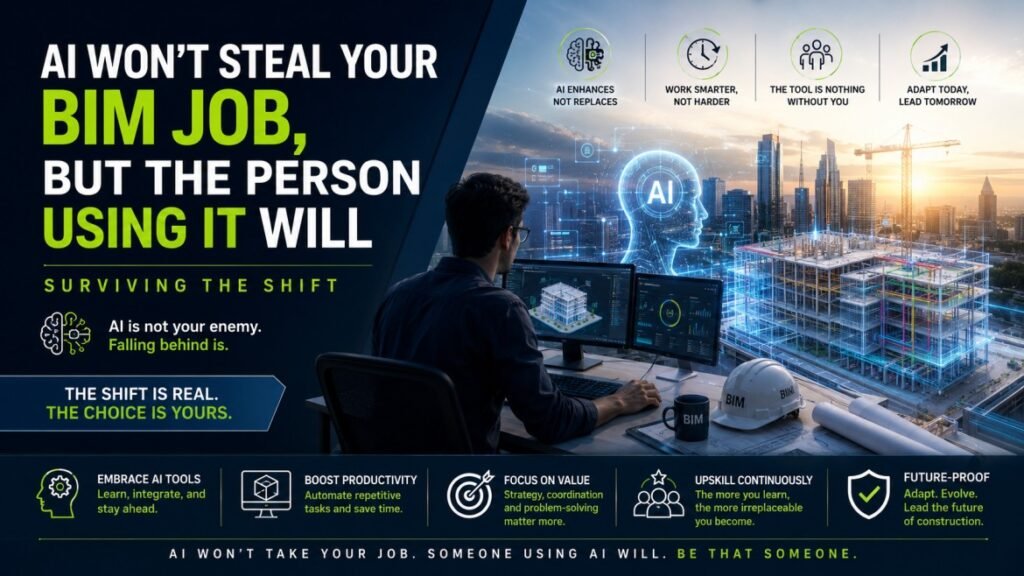
AI Won’t Steal Your BIM Job, But the Person Using It Will: Surviving the Shift
Introduction
AI won’t steal your BIM job. But the colleague sitting three desks away, the one who’s already running AI-assisted clash detection while you’re still manually checking drawings, might. That’s the uncomfortable truth nobody in the AEC industry wants to say out loud in 2026. The technology isn’t the threat. The skills gap is.
Here’s the reality check: AI in BIM 2026 isn’t some future possibility anymore. It’s already embedded in how firms plan, design, and deliver projects. So the real question isn’t “will AI replace me?” It’s “will I know how to use it before someone else does?” Let’s break down what’s actually happening, what the numbers say, and how you can come out ahead.
The Numbers Don’t Lie: AI Is Already Reshaping BIM Work
Let’s start with what’s measurable. According to the AGC/Sage 2026 Construction Outlook, 61% of construction firms now use AI or plan to increase their investment in it, up from 44% the prior year. That’s not a slow trend. That’s a sprint.
And the applications aren’t abstract. The most common uses right now are office and administrative functions, followed by estimating, then design and preconstruction work — all tasks that overlap directly with BIM workflows.
Meanwhile, the disruption risk varies wildly by role. Document controllers face roughly 85% disruption risk. CAD and draughting technicians sit at about 78%. Construction estimators come in around 71%. In short, the more repetitive and rule-based your daily tasks look, the higher your exposure.
But here’s the part that should genuinely worry you: as of 2026, roughly 68% of construction professionals globally have had zero formal AI or BIM training. So the gap isn’t between humans and machines. It’s between the trained 32% and everyone else.
Why “AI Will Take Your Job” Is the Wrong Framing
Let’s be clear about something important. AI isn’t walking onto a job site and replacing a BIM coordinator. Instead, it’s replacing specific tasks within that role — clash detection, drawing reviews, quantity takeoffs, and repetitive documentation.
Consequently, the professionals who thrive won’t be the ones who resist AI. They’ll be the ones who absorb it into their workflow and move up the value chain. As one industry analysis put it, the real risk in 2026 isn’t automation — it’s skill obsolescence. In other words, the danger isn’t that a machine does your job. It’s that you stop growing while the job around you changes shape.
This shift is already visible in hiring data too. Firms increasingly favor hybrid professionals who combine hands-on site experience with BIM and AI fluency, and these candidates are getting hired first and paid more. So the market has already made its verdict clear: adaptability beats specialization-without-growth.
Real Examples: AI Is Already Changing How BIM Gets Done
Numbers are one thing. Real projects make it concrete.
- AI-enhanced BIM cut planning errors by 40% on a New York City project — proof that clash detection and coordination tools aren’t hypothetical anymore; they’re delivering measurable results on live job sites.
- Deloitte’s 2026 Engineering & Construction Outlook notes that cloud-native digital twins and AI agents are expected to become standard across firms planning digital initiatives through the rest of the year.
- Meanwhile, labor shortages are compounding the pressure. The construction industry needs roughly 499,000 new workers in 2026, up from 439,000 the year before, and by 2031 an estimated 41% of the current workforce will retire. As a result, firms can’t simply hire their way out of the gap — they need existing teams to do more, faster, which is exactly where AI-literate BIM professionals become indispensable.
So the pattern is consistent: firms aren’t cutting BIM roles because of AI. They’re raising the bar for what a BIM professional needs to know.
What This Means for You
If you work in BIM — whether as a modeler, coordinator, manager, or MEP specialist — here’s the practical takeaway.
1. Audit your daily tasks. Which parts of your job are repetitive, rule-based, and pattern-driven? Those are the tasks AI will absorb first. Don’t fight that. Instead, learn the tools that automate them so you can spend your time on judgment calls AI still can’t make.
2. Move toward strategy, not just software skill. The professional who thrives isn’t the one who knows Revit shortcuts better than everyone else. It’s the one who can turn digital model data into real project decisions — cost, risk, sustainability, and delivery timing.
3. Get structured training, not YouTube fragments. Self-directed learning rarely works at scale. Structured programs deliver measurably better outcomes — trained professionals show significantly higher proficiency and retain those skills a year later, compared to people who try to piece it together alone.
4. Don’t wait for your employer to train you. Only about a third of professionals report receiving formal AI training in the past year, even though most employers admit they’re struggling to fill AI-related roles. If you wait for training to come to you, you’ll wait behind everyone who didn’t.
This is exactly the gap Castallio’s programs are built to close. Their Advance BIM Fundamental for Professional course gets you hands-on with the tools firms are actually adopting right now — not theory, but live project workflows with 1-to-1 mentorship. If you’re already working and want to move into leadership or digital strategy, the Advance BIM Management & Digital Strategy course goes further, covering ISO 19650, CDE workflows, and the kind of strategic thinking that keeps you above the automation line.
The Skills That Will Keep You Ahead
Based on where the industry is heading, a few specific skills stand out as the strongest hedge against BIM automation risk:
- AI-assisted clash detection and coordination — knowing how to direct and validate AI output, not just accept it
- Digital Twin and Common Data Environment (CDE) fluency — since cloud-native digital twins are becoming the industry standard
- Data governance and validation — someone still needs to catch when an AI-generated model or estimate is wrong
- Cross-disciplinary communication — bridging architecture, structural, and MEP teams, a skill no AI tool replicates
- Leadership and project strategy — turning data into decisions, not just producing more data
Notably, this list of AI tools for BIM engineers keeps growing every quarter. So staying current isn’t a one-time course. It’s an ongoing habit.
Conclusion: The Shift Is Already Happening
AI won’t steal your BIM job. That much is clear from the data — firms are adding AI to workflows, not eliminating the humans who run them. But the professional next to you who invests in BIM career survival skills now, while two-thirds of the industry sits on the sidelines, will absolutely out-earn and out-hire you within a few years.
The good news? You still have time to close that gap. The firms are hiring. The tools are accessible. And the training exists.
Ready to get ahead of the shift? Explore Castallio’s BIM courses → and start with the Advance BIM Fundamental Course or step up into leadership with the Advance BIM Management & Digital Strategy Course.