
BIM LOD Standards Explained: A Practical Guide to ISO 19650
BIM LOD standards define how much detail and reliability a model element carries at each stage of a project, and getting them wrong is one of the most expensive mistakes a design or construction team can make. So, whether you are writing a BIM Execution Plan, bidding on a government contract, or just trying to understand what a client means by “LOD 350,” this guide breaks down exactly what these standards require.
The stakes are higher than most teams realize. In fact, on complex MEP-heavy projects, coordinating at LOD 350 instead of LOD 300 lets teams resolve hundreds of extra clashes during preconstruction, where a fix costs a fraction of what it would in the field. Meanwhile, the global BIM in construction market is projected to grow from $5.04 billion in 2025 to $20.39 billion by 2035, a 15% CAGR according to Expert Market Research. As adoption accelerates, understanding BIM LOD standards alongside ISO 19650 has become essential, not optional, for anyone working in digital construction.
This article covers what LOD actually means, how ISO 19650 governs information management around it, and what both standards mean for your next project.
What Are BIM LOD Standards?
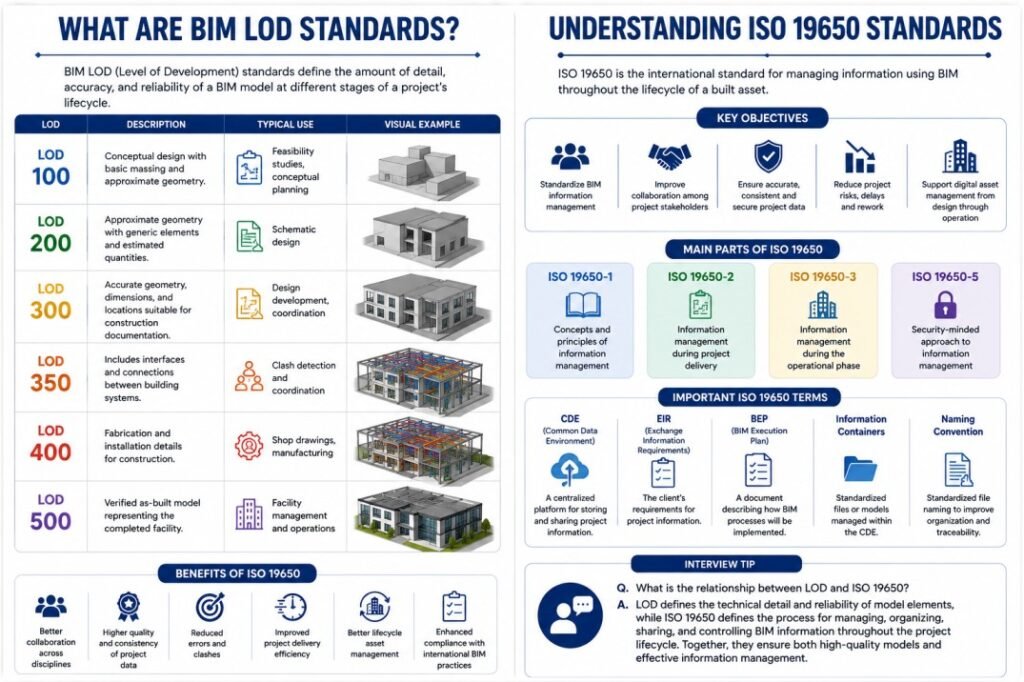
LOD, or Level of Development, is a framework that describes how complete and reliable a model element is at a given point in a project. It is not the same as “Level of Detail,” a common confusion; LOD measures how much a project team can rely on an element for design, coordination, estimating, or fabrication, not just how it looks visually.
The framework breaks down into six standard levels:
- LOD 100 — Conceptual massing. Elements appear as generic symbols conveying design intent only.
- LOD 200 — Approximate geometry. Generic systems and components with estimated sizes and locations.
- LOD 300 — Accurate geometry. Precise dimensions and placement suitable for construction documents.
- LOD 350 — Coordinated geometry. Adds interfaces and connections across trades for clash detection.
- LOD 400 — Fabrication-ready. Detailed enough for shop drawings and prefabrication.
- LOD 500 — Field-verified as-built. Confirmed through site observation, not design assumption.
In the US, the American Institute of Architects defines LOD 100, 200, 300, 400, and 500 through its E201 BIM contract exhibit. BIMForum’s separate LOD Specification then adds LOD 350 and a practical interpretation of LOD 500, and most commercial, industrial, and institutional project teams now reference this document directly inside their BIM Execution Plans.
Why BIM LOD Standards Matter for Your Project Budget
So, why do BIM LOD standards get so much attention on real projects? Because the level you choose has a direct, measurable impact on cost and schedule.
Consider a few practical examples:
- Under-modeling causes rework. LOD 300 alone often misses clearance clashes that LOD 350 would catch. On MEP-heavy projects, that gap can mean hundreds of unresolved conflicts surfacing during construction instead of during coordination meetings.
- Over-modeling wastes effort. Producing LOD 400 detail during schematic design forces constant rework every time the design changes, since fabrication-level information has to be revised alongside it.
- Off-site fabrication depends on LOD 400. As modularization and prefabrication grow in 2026, fabricators increasingly rely on LOD 400 models to cut steel joints, MEP ducting, and precast concrete to exact dimensions.
Additionally, teams should never assume LOD 500 is simply “more detailed than LOD 400.” LOD 500 is a separately recorded, field-verified condition confirmed through observation after construction, not a design deliverable at all. Getting that distinction right in a proposal or an execution plan signals real fluency with BIM LOD standards, not just familiarity with the numbers.
Want to build this level of fluency into your own workflow? Castallio’s Advance BIM Fundamental for Professional course walks through LOD application, model coordination, and clash resolution using real project files rather than abstract theory.
Understanding ISO 19650 Standards
While BIM LOD standards define model reliability, ISO 19650 defines something different: the process for managing information itself. ISO 19650 is the international standard for managing information across a built asset’s full lifecycle using BIM. It is not a software standard, and it does not require any specific tool. Instead, it establishes the processes, roles, and responsibilities around creating, reviewing, sharing, and storing project information.
Originally derived from the UK’s PAS 1192 framework, ISO 19650 standards are now adopted globally, with national annexes across Europe, the Middle East, Asia-Pacific, and the Americas. The standard is published across several parts:
- Part 1 — Concepts and principles, including information requirements, roles, and the Common Data Environment.
- Part 2 — Information management during the delivery phase, introducing the BIM Execution Plan and delivery plans.
- Part 3 — Information management during the operational phase, covering asset management and maintenance.
- Parts 4-6 — Information exchange quality, a security-minded approach, and health and safety information.
Central to all of this is the Common Data Environment, or CDE. A CDE is a governed environment used to collect, manage, review, approve, and distribute project information, replacing scattered file shares and email chains with one structured source of truth. Every information container in a compliant CDE moves through four defined states: Work in Progress, Shared, Published, and Archived, each with its own approval gate. Popular platforms supporting these workflows include Autodesk Construction Cloud, Trimble Connect, Bentley ProjectWise, and Aconex.
How ISO 19650 Standards Are Being Adopted Worldwide in 2026
ISO 19650 standards are no longer a UK-only concern. As of 2026, more governments are mandating BIM on public projects across the UK, UAE, Singapore, and Germany, and a proposed 2026 revision to the standard aims to tighten and simplify its language so it means the same thing wherever it’s applied. Consequently, firms bidding on international or Tier 1 government contracts increasingly treat ISO 19650 compliance as a baseline requirement rather than a bonus credential.
Adoption varies by region:
- United Kingdom — Required for all public infrastructure projects, the market where ISO 19650 originated from PAS 1192.
- Australia — No single mandated national standard exists yet, but ISO 19650 has become the de facto reference for major public projects, with state agencies like Transport for NSW increasingly referencing it directly.
- Middle East — Large-scale giga-projects are driving some of the most aggressive regional mandates for ISO 19650 compliance anywhere in the world.
- United States — No nationwide mandate exists, but the standard aligns closely with National BIM Standard (NBIMS) guidance, and federal and state agencies are piloting adoption through early case studies.
Overall, this global shift means BIM LOD standards and ISO 19650 increasingly work together on the same projects: LOD defines what a model element should contain, while ISO 19650 governs how that information gets created, approved, and exchanged between teams. For BIM Coordinator and BIM Manager roles specifically, Castallio’s Professional BIM Management & Digital Strategy Course covers BIM Execution Plan development and ISO 19650 alignment in depth, exactly the skill set employers are hiring for right now.
What This Means for You: Practical Takeaways
So, how should you apply all of this on your next project? Here is a short framework:
- Match LOD to project phase, not ambition. Don’t model LOD 400 detail during schematic design; align each element’s LOD to what that phase actually requires.
- Reference BIMForum by name in contracts. Ambiguous LOD language in a BEP creates disputes later; naming the specific specification avoids confusion.
- Set up your CDE to enforce the four-state model. Most teams already own a capable platform; the real work is configuring and enforcing the Work in Progress, Shared, Published, and Archived gates.
- Identify your ISO 19650 role early. Know whether you are the appointing party, lead appointed party, or an appointed party before drafting your Exchange Information Requirements.
- Treat compliance as a competitive advantage. As more government and international clients require ISO 19650 alignment, demonstrable compliance becomes a differentiator in proposals, not just a checkbox.
Common Misconceptions About BIM LOD Standards and ISO 19650
A few mix-ups come up constantly, even among experienced professionals:
- “LOD and Level of Detail are the same thing.” They are not. Level of Development measures reliability for downstream use; Level of Detail describes visual appearance only.
- “ISO 19650 mandates specific software.” It does not. The standard defines processes and roles, not tools, so any CDE platform can support it if configured correctly.
- “LOD 500 is just a more detailed LOD 400 model.” It isn’t. LOD 500 is a field-verified as-built record, established after construction, not a design-stage deliverable.
- “ISO 19650 only applies to buildings.” It applies to all built assets, including infrastructure, utilities, and transportation networks.
Conclusion: Put BIM LOD Standards and ISO 19650 Into Practice
Overall, mastering BIM LOD standards alongside ISO 19650 gives you a real advantage in a market that is standardizing fast. LOD tells your team how much to trust a model element; ISO 19650 tells your team how that information gets managed, approved, and exchanged across the entire project lifecycle. Together, they form the backbone of modern digital construction delivery.
Your next step is straightforward. Audit your current BIM Execution Plan against the BIMForum LOD Specification and the ISO 19650 four-state CDE model, and flag any gaps before your next project kickoff. If you want structured, project-based training to close those gaps faster, explore Castallio’s full course catalog at castallio.com and start building the standards fluency clients are increasingly demanding.