Revit and BIM Interview Questions Every Candidate Should Know
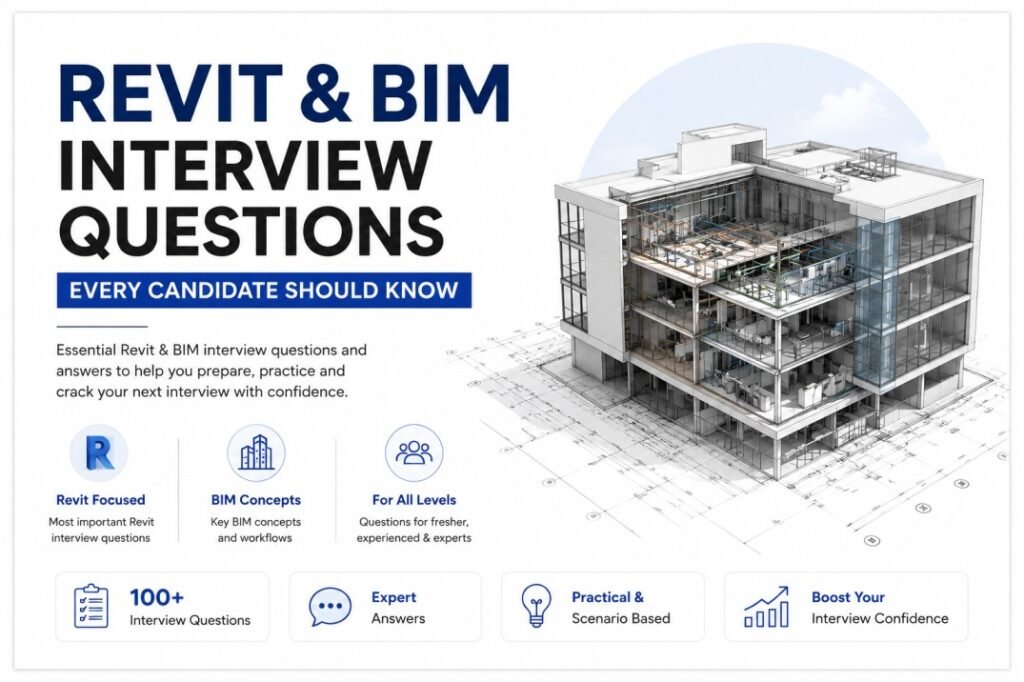
Landing a BIM role in 2026 starts with one thing: preparing the right Revit and BIM interview questions before you walk into the room. So, whether you are a fresh graduate or a five-year veteran switching firms, hiring managers now expect more than software familiarity. They want proof that you can model accurately, coordinate across disciplines, and think like a digital construction professional.
The stakes are real. According to Salary.com, average pay for a Revit BIM Modeler in the United States reached $94,045 a year in 2025, while BIM Managers now average $126,259 annually, with top earners crossing $148,000. Meanwhile, the global BIM in construction market is projected to grow from $5.04 billion in 2025 to $20.39 billion by 2035, a 15% CAGR according to Expert Market Research. As a result, competition for skilled candidates has intensified, and interviewers are raising the bar accordingly.
This guide breaks down the Revit and BIM interview questions that actually come up in 2026 interviews, organized by experience level, with practical answer frameworks you can adapt to your own project history.
Why Revit and BIM Interview Questions Matter More in 2026
BIM adoption is no longer optional in most AEC markets. In fact, G2 research found that 70% of construction professionals have already deployed BIM, with another 18% planning to adopt it soon. Additionally, users report up to a 48% reduction in rework once BIM-driven coordination replaces traditional 2D workflows.
That shift changes what interviewers screen for. Consequently, Revit and BIM interview questions today rarely stop at “what is a family?” Instead, they probe how you troubleshoot a broken worksharing session, resolve a MEP clash, or manage a Common Data Environment under ISO 19650. So, if your prep still lives in 2020, it is time for an update.
For a structured path through these fundamentals, Castallio’s Advance BIM Fundamental for Professional course walks candidates through the exact modeling and coordination skills interviewers test for, using real project scenarios rather than isolated software tutorials.
Foundational Revit Interview Questions (Entry-Level)
These questions target fresh graduates and candidates with under two years of experience. Interviewers use them to confirm you understand core Revit mechanics before testing anything advanced.
1. How is Revit different from AutoCAD?
AutoCAD draws 2D geometry, while Revit builds a parametric, data-rich 3D model. Every element in Revit connects to every other element, so a change in one view instantly updates all related views, schedules, and sheets. In short, AutoCAD shows geometry; Revit represents building intelligence.
2. What is bidirectional associativity?
Bidirectional associativity is the core Revit behavior where edits made in any view automatically propagate across the entire model. For example, resizing a wall in a floor plan updates that wall in every section, elevation, and schedule tied to it. This eliminates the manual coordination that traditional CAD workflows require.
3. What is the difference between a system family and a loadable family?
System families (walls, floors, roofs) exist inside the Revit project template and cannot be saved as separate files. Loadable families (doors, windows, furniture) live in external .rfa files and can be imported into any project. Understanding this distinction matters for effective family creation and long-term model management.
4. What is View Range, and why does it matter?
View Range controls what elements appear in a plan view based on cut plane, top, and bottom boundaries. Properly configured View Range is essential for accurate floor plans, particularly in multi-story buildings where overlapping levels can cause confusing or misleading documentation.
5. Walk me through the typical Revit project lifecycle.
Most projects move through conceptualization, design development, documentation, construction, and maintenance. Modelers typically begin with massing studies, then refine geometry using accurate families, levels, and materials as the design matures. Recruiters ask this to confirm you understand where your role fits in the bigger picture.
Intermediate Revit and BIM Interview Questions (2-5 Years Experience)
Once you clear the basics, interviewers shift toward workflow and coordination skills. These Revit and BIM interview questions test whether you can deliver real value on a live project, not just recite definitions.
6. How do worksets and worksharing support team collaboration?
Worksharing splits a central model into worksets, allowing multiple team members to edit the same project simultaneously without overwriting each other’s work. For multi-location teams, Revit Cloud Worksharing extends this further by enabling real-time collaboration across offices through Autodesk’s cloud infrastructure. Be ready to describe a time you resolved a worksharing conflict or synced a corrupted local file.
7. How do you handle phasing in a renovation project?
Phasing organizes elements by construction timeline, letting you display existing conditions, demolition, and new construction within the same model. This matters enormously on retrofit work, and retrofit demand is climbing fast; aging public infrastructure is now a major growth driver for BIM adoption, according to Expert Market Research’s latest industry report.
8. How do you coordinate linked models between disciplines?
Linked models let architectural, structural, and MEP teams work in separate files while still referencing each other’s geometry for coordination. Typically, you would run clash detection in Navisworks, log issues, and route them back to the responsible discipline lead. Additionally, agreeing on shared coordinates and file naming conventions early prevents painful rework later.
9. How do you optimize model performance on a large project?
Large models slow down when they carry excessive detail or poorly managed components. So, experienced modelers reduce unnecessary geometry, purge unused families regularly, and keep components inside a unified coordinate system. Tools like Navisworks also help offload heavy coordination tasks away from the live Revit file.
10. Describe a modeling mistake you made and how you fixed it.
This behavioral question checks accountability, not perfection. A strong answer names the specific error, explains the root cause, and describes the process fix you implemented afterward. Interviewers want to see that you learn from mistakes rather than repeat them.
Ready to build these skills hands-on rather than just answer questions about them? Castallio’s Advance BIM Fundamental for Professional course covers worksharing, phasing, and multi-discipline coordination through real project files.
Advanced BIM Coordination and Management Questions
Senior roles, especially BIM Coordinator and BIM Manager positions, demand fluency in standards, governance, and cross-team leadership. These Revit and BIM interview questions separate technical modelers from strategic BIM professionals.
11. What is a Common Data Environment (CDE), and why does it matter?
A CDE is the shared digital space where project teams store, manage, and exchange information under agreed approval statuses. The biggest risk without one is someone building from outdated or unapproved data, which causes rework, delays, and disputes. Strong CDE governance, clear status codes, and disciplined publishing cycles are the most reliable ways to reduce that risk.
12. How do you manage interoperability across BIM software?
Interoperability starts with agreeing on exchange formats such as IFC or NWC/NWD, plus shared coordinate systems and file naming conventions, before modeling even begins. After each exchange, validate the delivered model in an independent viewer and confirm units and coordinates line up. The goal is avoiding format surprises late in the project, since interoperability issues discovered near delivery are far more expensive to fix.
13. Explain BIM maturity levels and why interviewers ask about them.
BIM maturity frameworks vary by region and standard, but the underlying idea stays consistent: maturity increases as standardization, interoperability, and controlled information exchange improve. Interviewers use this question to see whether you understand BIM as a process, not just a modeling tool.
14. How would you structure a BIM Execution Plan (BEP) for a new project?
A solid BEP defines model ownership, level of development (LOD) targets, naming standards, exchange schedules, and clash resolution workflows before a single wall gets modeled. Consequently, teams that skip this step tend to face coordination chaos by mid-project. Mention any experience aligning a BEP with ISO 19650 requirements if you have it.
15. How do you train or mentor junior modelers on your team?
BIM Managers increasingly own upskilling responsibilities as firms scale their digital teams. Describe a specific onboarding process, standard operating procedure, or template library you built to reduce ramp-up time for new hires.
What This Means for You: Practical Interview Takeaways
So, how should you actually use this list? Here is a short framework for turning these Revit and BIM interview questions into a real prep plan:
- Match your answers to your experience level. Entry-level candidates should nail the foundational questions cold; senior candidates need fluent, specific answers on governance and coordination.
- Bring project evidence, not just theory. For every question, prepare one real example from your portfolio: a clash you resolved, a schedule you automated, a phasing plan you built.
- Know the current numbers. Citing salary benchmarks or adoption statistics during a negotiation conversation signals that you follow the industry, not just the software.
- Practice explaining “why,” not just “how.” Interviewers increasingly probe judgment: why you chose a particular family strategy, why you flagged a clash as critical, why you structured worksets a certain way.
- Stay current on 2026 workflows. Cloud collaboration, multi-discipline linking, and AI-assisted clash checks are now standard expectations, not bonus skills.
For candidates targeting BIM Manager or BIM Coordinator roles specifically, Castallio’s Professional BIM Management & Digital Strategy Course covers BEP development, ISO 19650 alignment, and CDE governance in depth, exactly the material senior interview panels probe hardest.
Certifications and Skills That Strengthen Your Answers
Interviewers respond well to verifiable credentials. Industry research cited by ConstructionPlacements found that professionals holding Autodesk certifications, alongside working knowledge of tools like Navisworks and Dynamo, earn 30-50% more than non-certified peers. So, if you have not yet pursued an Autodesk Certified Professional credential, it is worth the investment before your next interview cycle.
Beyond certification, firms increasingly value candidates who can move fluidly between Revit, Navisworks, and emerging AI-based checking tools. The UK, for instance, pioneered mandatory BIM for public projects and now sees over 70% of AEC firms using some form of BIM, according to ConstructionPlacements’ 2026 careers report. That maturity raises the bar for what “BIM proficient” actually means on a resume.
Common Mistakes Candidates Make in BIM Interviews
Even strong technical candidates stumble in predictable ways. Watch out for these:
- Reciting definitions without examples. Interviewers can tell when an answer is memorized rather than experienced.
- Ignoring collaboration skills. Revit work is rarely solitary; most roles require constant coordination with architects, engineers, and contractors.
- Skipping the “why” behind technical choices. Explaining your reasoning shows judgment, which matters more than raw software knowledge.
- Underselling soft skills. Communication and adaptability now rank alongside technical depth, especially as firms adopt new cloud and AI tools mid-career.
Conclusion: Turn Preparation Into Your Advantage
Overall, mastering Revit and BIM interview questions is less about memorizing answers and more about demonstrating how you think through real modeling and coordination problems. The market rewards that preparation directly: BIM salaries are climbing, adoption is accelerating, and firms are actively competing for candidates who combine software fluency with process discipline.
Your next step is simple. Review the questions above, map each one to a real project story from your own experience, and practice explaining your reasoning out loud. If you want structured, project-based training to close any remaining gaps, explore Castallio’s full course catalog at castallio.com and start building the portfolio that gets you hired.