Enroll in the New Advance Transportation Design Using Civil 3D & QGIS for Professional Batch Starting 10 September 2026 – Now Available Online

BIM salary India

Revit & BIM Interview Questions Every Candidate Should Know

Revit and BIM Interview Questions Every Candidate Should Know Landing a BIM role in 2026 starts with one thing: preparing the right Revit and BIM interview questions before you walk into the room. So, whether you are a fresh graduate or a five-year veteran switching firms, hiring managers now expect more than software familiarity. They want proof that you can model accurately, coordinate across disciplines, and think like a digital construction professional. The stakes are real. According to Salary.com, average pay for a Revit BIM Modeler in the United States reached $94,045 a year in 2025, while BIM Managers now average $126,259 annually, with top earners crossing $148,000. Meanwhile, the global BIM in construction market is projected to grow from $5.04 billion in 2025 to $20.39 billion by 2035, a 15% CAGR according to Expert Market Research. As a result, competition for skilled candidates has intensified, and interviewers are raising the bar accordingly. This guide breaks down the Revit and BIM interview questions that actually come up in 2026 interviews, organized by experience level, with practical answer frameworks you can adapt to your own project history. Why Revit and BIM Interview Questions Matter More in 2026 BIM adoption is no longer optional in most AEC markets. In fact, G2 research found that 70% of construction professionals have already deployed BIM, with another 18% planning to adopt it soon. Additionally, users report up to a 48% reduction in rework once BIM-driven coordination replaces traditional 2D workflows. That shift changes what interviewers screen for. Consequently, Revit and BIM interview questions today rarely stop at “what is a family?” Instead, they probe how you troubleshoot a broken worksharing session, resolve a MEP clash, or manage a Common Data Environment under ISO 19650. So, if your prep still lives in 2020, it is time for an update. For a structured path through these fundamentals, Castallio’s Advance BIM Fundamental for Professional course walks candidates through the exact modeling and coordination skills interviewers test for, using real project scenarios rather than isolated software tutorials. Foundational Revit Interview Questions (Entry-Level) These questions target fresh graduates and candidates with under two years of experience. Interviewers use them to confirm you understand core Revit mechanics before testing anything advanced. 1. How is Revit different from AutoCAD? AutoCAD draws 2D geometry, while Revit builds a parametric, data-rich 3D model. Every element in Revit connects to every other element, so a change in one view instantly updates all related views, schedules, and sheets. In short, AutoCAD shows geometry; Revit represents building intelligence. 2. What is bidirectional associativity? Bidirectional associativity is the core Revit behavior where edits made in any view automatically propagate across the entire model. For example, resizing a wall in a floor plan updates that wall in every section, elevation, and schedule tied to it. This eliminates the manual coordination that traditional CAD workflows require. 3. What is the difference between a system family and a loadable family? System families (walls, floors, roofs) exist inside the Revit project template and cannot be saved as separate files. Loadable families (doors, windows, furniture) live in external .rfa files and can be imported into any project. Understanding this distinction matters for effective family creation and long-term model management. 4. What is View Range, and why does it matter? View Range controls what elements appear in a plan view based on cut plane, top, and bottom boundaries. Properly configured View Range is essential for accurate floor plans, particularly in multi-story buildings where overlapping levels can cause confusing or misleading documentation. 5. Walk me through the typical Revit project lifecycle. Most projects move through conceptualization, design development, documentation, construction, and maintenance. Modelers typically begin with massing studies, then refine geometry using accurate families, levels, and materials as the design matures. Recruiters ask this to confirm you understand where your role fits in the bigger picture. Intermediate Revit and BIM Interview Questions (2-5 Years Experience) Once you clear the basics, interviewers shift toward workflow and coordination skills. These Revit and BIM interview questions test whether you can deliver real value on a live project, not just recite definitions. 6. How do worksets and worksharing support team collaboration? Worksharing splits a central model into worksets, allowing multiple team members to edit the same project simultaneously without overwriting each other’s work. For multi-location teams, Revit Cloud Worksharing extends this further by enabling real-time collaboration across offices through Autodesk’s cloud infrastructure. Be ready to describe a time you resolved a worksharing conflict or synced a corrupted local file. 7. How do you handle phasing in a renovation project? Phasing organizes elements by construction timeline, letting you display existing conditions, demolition, and new construction within the same model. This matters enormously on retrofit work, and retrofit demand is climbing fast; aging public infrastructure is now a major growth driver for BIM adoption, according to Expert Market Research’s latest industry report. 8. How do you coordinate linked models between disciplines? Linked models let architectural, structural, and MEP teams work in separate files while still referencing each other’s geometry for coordination. Typically, you would run clash detection in Navisworks, log issues, and route them back to the responsible discipline lead. Additionally, agreeing on shared coordinates and file naming conventions early prevents painful rework later. 9. How do you optimize model performance on a large project? Large models slow down when they carry excessive detail or poorly managed components. So, experienced modelers reduce unnecessary geometry, purge unused families regularly, and keep components inside a unified coordinate system. Tools like Navisworks also help offload heavy coordination tasks away from the live Revit file. 10. Describe a modeling mistake you made and how you fixed it. This behavioral question checks accountability, not perfection. A strong answer names the specific error, explains the root cause, and describes the process fix you implemented afterward. Interviewers want to see that you learn from mistakes rather than repeat them. Ready to build these skills hands-on rather than just answer questions about them? Castallio’s Advance BIM Fundamental for

Revit & BIM Interview Questions Every Candidate Should Know Read More »

Clash Detection in BIM The Complete 2025-26 Guide for Architects & Engineers

Clash Detection in BIM The Complete 2025-26 Guide for Architects & Engineers

Compared​‍​‌‍​‍‌​‍​‌‍​‍‌ to ten years ago, construction is a totally different thing today. Structures are more complicated, there are less days to complete the works, and customers demand perfect results. In such a circumstance, a tiny error in the design of a duct crossing a beam can result in a substantial delay and extra expenses being caused at the construction site. That is the place where Clash Detection in BIM comes. It has become one of the most significant parts of the design and coordination process in 2025. The main idea is not to uncover the problems when building the structures but to find out the issues in the digital models and solve them before the site is ready. If you are an architect, engineer, or a member of any construction team, it is not only handy but also necessary to know what clash detection is. This guide provides all the information in a simple, understandable ​‍​‌‍​‍‌​‍​‌‍​‍‌manner. What Is Clash Detection in BIM? Think​‍​‌‍​‍‌​‍​‌‍​‍‌ of it as if you are making a house. The architect puts the wall. The electrician wires the house. The plumber pipes the house. What if it is that—without knowing—the pipe is in the same place as the electrical conduit? It’s a clash. BIM clash detection is all about resolving those conflicts inside the 3D digital model before the team arrives on the site. Instead of finding out the mistake after the materials are bought or the walls are built, the BIM model shows it at the very beginning, thus, saving time and money. Those are the places where the conflicts normally arise between: Architectural vs. Structural elements Structural vs. MEP elements MEP vs. MEP systems Or even in the project schedule (4D clashes) Comparing your planning with the real world, clash detection is that “reality check” of construction ‌ ‌ ‌  ​‍​‌‍​‍‌​‍​‌‍​‍‌planning. Why Clash Detection Matters in 2025-26 More Than Ever The​‍​‌‍​‍‌​‍​‌‍​‍‌ way construction operates is changing. The projects are grander. The MEP systems are complicated to a higher degree. The sustainability rules are getting stricter. And delays cost more and more. It has become clash detection, which the industry cannot do without in 2025. It really saves a lot of money If you remove a clash from the design in a couple of minutes, you can hardly imagine it taking a few minutes. Removal on the spot can, however, bring the whole project to a halt. Clash detection makes sure that there are no: Wasted materials Systems that have been installed already, but redoing them Design changes at the last minute Unplanned rework Moreover, it collaborates better Architects, engineers, and contractors may not necessarily use the same approach when designing. So, what clash detection does is that it gathers all the models in one space where the interaction of the works can be seen by everyone. The construction process is speeded up by it As long as the design is neat and coordinated, the installation will be easy and anticipated. No more “stop work” situations when teams stumble upon the overlapped areas which had not been considered. Additionally, it is a great help for prefabrication The components to be prefabricated should have accurate measurements. Clash detection is the one that guarantees that each and every dimension and clearance is right prior to the production of the ​‍​‌‍​‍‌​‍​‌‍​‍‌parts. Types of Clashes in BIM 1.​‍​‌‍​‍‌​‍​‌‍​‍‌ Hard Clashes These are the main, tangible issues. Example: A duct going through a beam. A pipe going through a column. These are the ones that have the power to bring a project to a halt instantly if they are not discovered early. 2. Soft Clashes These refer to comfort, safety, or maintenance aspects. Example: An HVAC unit that doesn’t have enough space for servicing. A fire panel that can’t be fully opened. These do not physically collide but create operational issues. 3. Workflow or 4D Clashes These are the issues related to time. Example: The schedule shows that electrical work will start before the walls are built. 4D clashes are the change of the sequences that pinpoint the errors that can be the cause of the timeline being ​‍​‌‍​‍‌​‍​‌‍​‍‌disrupted. How Clash Detection Happens 1.​‍​‌‍​‍‌​‍​‌‍​‍‌ Integration of All Models Separate architectural, structural, and MEP models are combined into a single federated model. Commonly used are such tools as Navisworks and Revizto. 2.Clash Rules Are Defined The teams decide: <br> Elements to be checked <br> Required spacing <br> Priority of systems  Here the step prevents the false matches that are unnecessary. 3. The Software Performs Automated Clash Tests The software reviews the whole model and creates the conflicts that can be found along with the screenshots and the exact locations. 4. Clashes Are Studied, and Categorized Not all clashes are a crisis.  Teams classify them into: <br> Critical <br> Important <br> Minor <br> Acceptable  That helps people to deal with the amount of work. 5.Coordination Meetings Occur Discussion of clashes and agreeing on solutions are the objectives of the meeting of all the architects, structural engineers, and MEP teams. 6.Model Updating The teams reflect on their model changes as per the decisions made. <br> New editions are uploaded, checked, and confirmed. 7.Final Model Without Clashes After all the rechecks and revisions, the model is good to go and will be used for the next stage of the ​‍​‌‍​‍‌​‍​‌‍​‍‌project. Tools That Power Clash Detection in 2025-26 The​‍​‌‍​‍‌​‍​‌‍​‍‌ major arsenal of tools are: Autodesk Navisworks Manage Solibri Office Revizto BIMcollab Revit Coordination Tools Most tools today offer cloud coordination, issue tracking in real-time, and AI assistance. What teams really feel is the impact of clash detection Here is the truth of the matter: when clash detection is employed appropriately, these are the results that follow: Projects get completed in less time Designs become more precise Stakeholders communicate more effectively Less number of RFIs and change orders Installation processes become safer Higher quality standards Better utilization of prefabrication Enhanced mutual trust among ​‍​‌‍​‍‌​‍​‌‍​‍‌teams Challenges Teams Still Face Even​‍​‌‍​‍‌​‍​‌‍​‍‌ with BIM, clash detection is not completely

Clash Detection in BIM The Complete 2025-26 Guide for Architects & Engineers Read More »

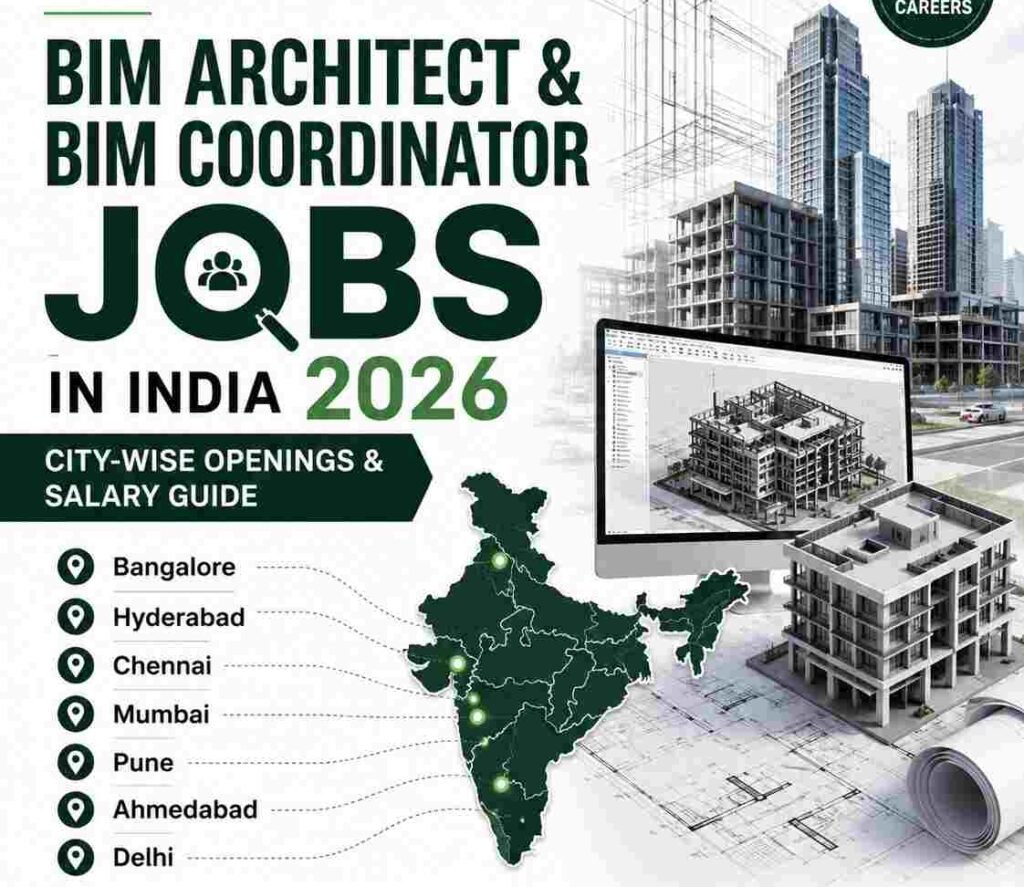
BIM Architect & BIM Coordinator Jobs in India 2026: City-Wise Openings and Salary Guide (Bangalore, Hyderabad, Chennai, Mumbai, Pune, Ahmedabad, Delhi)

Building Information Modeling has stopped being a “nice-to-have” skill in Indian AEC and turned into a hiring requirement. With the government mandating BIM on large central infrastructure projects, global majors like AECOM, WSP, Arcadis, and Jacobs running full-scale delivery centres out of India, and metro, data-centre, and industrial projects multiplying across the country, demand for trained BIM Architects and BIM Coordinators has never been higher. BIM Fundamental training If you’re evaluating a BIM career — or a switch from traditional CAD/architecture roles — this guide breaks down where the jobs actually are, city by city, and what each role realistically pays in 2026. Why BIM hiring is accelerating in 2026 A few forces are driving this hiring wave: Government mandates. BIM is now required on all central infrastructure projects above ₹100 crore, and the Union Budget’s infrastructure allocation is fueling projects across metro rail, highways, and smart cities. Global delivery centres. International firms are setting up large BIM teams in India to serve UK, Middle East, and Australian projects, which pushes up both hiring volume and pay, since India-based professionals working on international projects typically earn a premium over those on domestic-only projects. ISO 19650 adoption. Indian firms chasing international contracts are aligning with the ISO 19650 information management standard, creating fresh demand for certified BIM coordinators and managers who understand Common Data Environment (CDE) workflows. Post-pandemic efficiency pressure. Contractors and developers are adopting BIM specifically to cut rework and compress timelines, which is pulling BIM roles in-house at EPC and construction firms that previously outsourced this work. career support and placement assistance City-by-city job market overview Bangalore (Bengaluru) — the largest BIM job market in India Bengaluru has the single highest concentration of BIM openings in the country right now, with hundreds of live postings at any given time. It’s home to major delivery centres for WSP, AECOM, Arcadis, and Jacobs, alongside strong demand from data-centre and IT-campus projects. WSP alone is running multiple simultaneous searches here — BIM Coordinator, BIM Technician (Rail), BIM Technician (Architecture), and BIM Technician (Electrical). Prestige Group and other major developers also hire BIM Coordinators directly for live residential and commercial projects. BIM Management course Best for: Freshers and mid-level professionals looking for volume and variety; anyone targeting data-centre or IT-campus specialization. Hyderabad — the fastest-rising BIM corridor Hyderabad’s BIM job market is expanding quickly, driven by its growing IT-BIM corridor and a strong base of pharma and industrial plant projects. Arcadis is actively hiring BIM Modellers and Managers here, and the city is becoming a recognized hub for MEP-heavy BIM coordination tied to pharmaceutical and plant construction. Best for: MEP specialists and professionals interested in industrial/pharma plant BIM. Chennai — steady EPC and infrastructure demand Chennai’s BIM market leans toward EPC contractors and infrastructure-linked roles rather than pure design-consultancy work. It’s a smaller market than Bangalore or Hyderabad but consistently active, particularly for structural and civil infrastructure BIM. Best for: Civil/structural BIM professionals and those preferring EPC-side roles over design consultancies. Mumbai — highest-paying market, EPC and real estate heavy. Mumbai currently offers the highest BIM modeler and coordinator packages in India, largely because so many EPC and MEP contractor head offices are based there, along with a dense real-estate development market. Arcadis, Colliers, and several large developer-side firms hire consistently out of Mumbai. Best for: Professionals prioritizing salary over city cost-of-living tradeoffs; MEP and EPC-focused careers. Pune — the fastest-growing city for BIM in 2026 Pune is closing the gap with Mumbai fast. Pune Metro Line 3 broke ground in May 2026, and the city is currently running more than 40 BIM-enabled infrastructure projects simultaneously, alongside a strong base of IT-campus and industrial work. It’s increasingly seen as the best combination of job volume, salary growth, and livability among Tier-1 BIM markets. Best for: Professionals wanting strong growth potential without Mumbai/Bangalore cost of living — and a natural fit if you’re training out of Pune already. Ahmedabad — smaller market, lower competition Ahmedabad’s BIM job market is considerably smaller than the five cities above, but it’s growing alongside Gujarat’s industrial and infrastructure investment. Competition for roles here is noticeably lower, which can work in favor of professionals willing to relocate for faster career progression, even at slightly lower starting packages. Best for: Early-career professionals looking for faster hands-on responsibility with less competition. Delhi NCR (Delhi, Gurugram, Noida) — government and institutional stronghold Most roles tagged “Delhi” on job portals are actually based in Gurugram or Noida — worth knowing before you filter your search. Delhi NCR leads the country in government and institutional BIM projects, and pay here tracks closely with Noida. BIM Architect roles are especially active in Gurugram, with several firms hiring directly for architectural BIM modeling and construction documentation. Best for: Government/institutional project experience; BIM Architect roles specifically. BIM salary guide 2026: role-wise breakdown Salaries vary by role, experience, city, and specialization (MEP typically pays 20–40% more than architectural BIM at the same experience level, due to the added coordination complexity of mechanical, electrical, and plumbing systems). Here’s the realistic range based on current Indian job market data: Role Experience Salary Range (LPA) BIM Modeler (fresher/entry) 0–2 years ₹3.0 – 5.5 BIM Modeler (mid-level) 2–5 years ₹5.0 – 9.5 BIM Engineer 2–5 years ₹5.0 – 10.0 BIM Engineer (senior) 5+ years ₹7.0 – 18.0 BIM Coordinator 3–6 years ₹7.0 – 12.0 Senior BIM Coordinator 7+ years ₹10.0 – 15.0 MEP BIM Coordinator 2–6 years ₹6.0 – 14.0 BIM Manager 5–7+ years ₹9.0 – 20.0+ BIM Implementation Lead (data centre/industrial) Senior/specialist ₹18.0 – 22.0+ A few things worth noting on pay: Autodesk Certified Professional (ACP) certification in Revit typically commands a 15–25% premium over uncertified candidates at the same experience level. Tool stack depth matters. Revit alone gets you hired; adding Navisworks (clash detection) typically adds ₹1.5–2 LPA to your market rate, and Autodesk Construction Cloud (ACC) proficiency adds another ₹1–1.5 LPA. International project exposure (UK, Middle East, Australia) can push salaries 30–40% above domestic-only equivalents. Civil 3D for

BIM Architect & BIM Coordinator Jobs in India 2026: City-Wise Openings and Salary Guide (Bangalore, Hyderabad, Chennai, Mumbai, Pune, Ahmedabad, Delhi) Read More »

BIM Manager

BIM Manager Salary in 2026: What You Really Earn in India & Abroad

Some years back, BIM was only a “nice, to, have” kind of skill. Now, in 2026, it is the backbone of the construction industry altogether. Today, companies in industries such as airports, metros, data centers, and smart cities do not only require BIM models but BIM leaders as well. That’s exactly where the role of a BIM Manager comes into play. If you have these questions: Is BIM Manager a high paying position? What can I earn in India in 2026? Is it worth changing from BIM Coordinator to BIM Manager? We will be straightforward here and uncover the truth, no hype, just reality. What Does a BIM Manager Actually Do? A BIM Manager is more than just a modeler at a senior level. Once you get to this position, your role changes from “performing BIM” to “facilitating BIM for everyone”. Establishes BIM standards and workflowsLeads BIM teams (modelers & coordinators)Coordinates A&E, Structure, and MEPChecks models for quality, clashes, and informationCollaborates with clients, consultants, and contractorsMakes sure projects adhere to BIM mandates and ISO standardsBasically, you step up as a decision, maker, rather than just an adept software user. BIM Manager Salary in India (2026 – Real Numbers) Lets talk about money because that’s basically why you came here, right? In India, BIM Manager salaries have been on the rise for a long time, thanks to Big infrastructure projects (airports, metros, highways)Global companies outsourcing BIM, related work to IndiaIncreasing adoption of Digital Twins and smart assets Average BIM Manager Salary in India (2026) Experience Salary Range 6–8 years ₹12 – ₹18 LPA 8–10 years ₹18 – ₹26 LPA 10+ years ₹26 – ₹40+ LPA Cities that pay more: Bangalore, Pune, Mumbai, Hyderabad, Delhi NCR Many senior BIM Managers working with international clients or EPC companies comfortably earn ₹35–45 LPA. BIM Manager Salary Abroad (2026) Globally, BIM Managers are treated as digital construction leaders, not just engineers. Here’s what professionals are earning in 2026: United States: $100,000 – $140,000/year United Kingdom: £60,000 – £90,000/year UAE: AED 28,000 – 45,000/month Canada: CAD 90,000 – 130,000/year Australia: AUD 110,000 – 150,000/year If you understand international BIM standards and workflows, global opportunities open up fast. Why Some BIM Managers Earn More Than Others Here are some reasons why BIM Managers salaries vary: 1. Project Type Makes a Difference BIM Managers involved in projects such as: AirportsMetro railData centerLarge EPC infrastructuretend to get higher salaries than those working in small residential projects. 2. Software & Technology Skills Jobs with higher pay are often associated with a great mastery of the following tools: Autodesk RevitNavisworksAutodesk Construction CloudSynchroThe more you can interpret the workflow and data, the greater your worth. 3. BIM Standards Proficiency By 2026, the industry will expect BIM Managers to be adept at: ISO 19650BIM Execution Plans (BEP)LOD & LOICommon Data Environment (CDE)This is Skills That Push Your Salary Up The highest-paid BIM Managers are not just technical experts. Technical Skills Advanced coordination & clash management 4D & 5D BIM understanding Digital Twin basics Model quality audits Automation using Dynamo or Python Management Skills Leading teams Communicating with clients Training junior staff Handling BIM implementation at company level By 2026, people who combine BIM + leadership earn the most. Career Growth: How People Actually Become BIM Managers No one becomes a BIM Manager overnight. Most professionals follow this path: BIM Modeler Senior BIM Modeler BIM Coordinator Senior BIM Coordinator BIM Manager After this, many move into: Digital Engineering Manager Head of BIM Digital Construction Lead BIM Consultant or Trainer Some even start their own BIM service companies. Is BIM Manager a Good Career in 2026 and Beyond? Short answer: Yes—if you do it right. Why BIM Managers are future-proof: BIM is becoming mandatory Digital Twins are growing fast Smart infrastructure needs data-driven leaders There are more projects than skilled BIM Managers The role is shifting from software-based to strategy-based—and that’s a good thing. Final Thoughts The BIM Manager salary in 2026 reflects how important digital construction has become. In India, earning ₹18–40+ LPA is realistic if you have the right experience, skills, and mindset. But remember— BIM Manager is not about knowing every button in software.  It’s about understanding process, people, and projects. If you focus on skills + standards + leadership, BIM can give you: Strong income Global opportunities Long-term career stability And that’s rare in today’s job market.

BIM Manager Salary in 2026: What You Really Earn in India & Abroad Read More »