
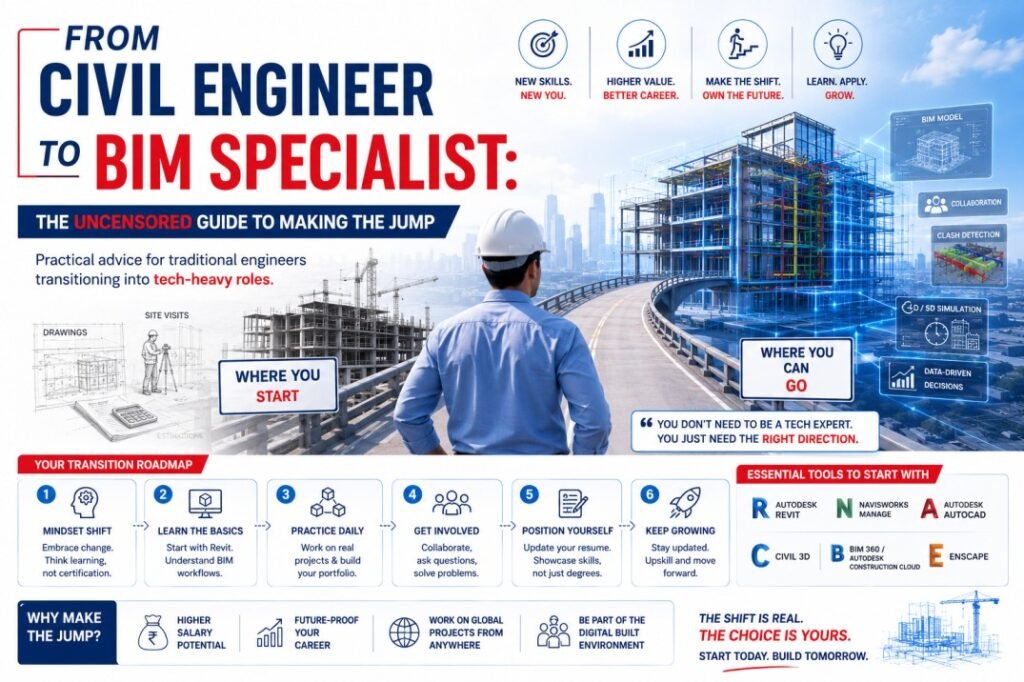
Civil Engineer to BIM Specialist: The Uncensored Guide to Making the Jump
Making the move from civil engineer to BIM specialist isn’t just a software upgrade. It’s a genuine career pivot, and nobody talks honestly about how uncomfortable that first year actually feels. So let’s skip the polished LinkedIn version and get into what this transition really involves — the pay bump, the identity shift, and the parts nobody warns you about before you start.
Here’s why this matters right now. According to the U.S. Bureau of Labor Statistics, the median annual salary for civil engineers sat at $95,890 in May 2026. That’s a solid number. But specializing in BIM pushes you toward the upper end of that range and beyond, with BIM Directors now clearing $180,000 or more in competitive markets. So the question isn’t whether the jump pays off. It’s whether you’re prepared for what the jump actually requires.
Why Civil Engineers Are Making This Move in 2026
The shift from civil engineer to BIM specialist isn’t a fringe trend anymore. It’s become one of the most common career pivots inside the AEC industry.
For years, doing your part of the design well was enough. That’s no longer true. Projects now depend on how well different disciplines fit together, not just how well each person handles their own piece. BIM exists specifically to solve that coordination problem, and it’s rewriting how engineers think about their work. Decisions aren’t isolated anymore — they ripple across the whole project.
Meanwhile, the money backs up the shift. In India, entry-level BIM professionals now earn between INR 4-6 lakhs, while senior BIM managers pull in upwards of INR 15 lakhs. Globally, McKinsey & Company projects that digital construction — including BIM — will contribute over $1.2 trillion by 2030. So this isn’t a niche skill anymore. It’s where the budget, and the hiring, is heading.
The Uncomfortable Truth Nobody Tells You
Let’s get into the parts most guides skip. This transition isn’t just about learning new software. It’s about relearning how you think about your own value on a project.
1. You’ll feel like a beginner again — and that’s normal. You spent years building expertise as a civil engineer. Then you sit down in front of Revit, and suddenly you’re the least confident person in the room. That’s not a sign you made the wrong choice. It’s simply what learning a new discipline feels like, even for experienced professionals.
2. Software fluency isn’t the hard part. Understanding Autodesk Revit and how to use it isn’t actually the real challenge. The genuine difficulty is figuring out how BIM changes your organization’s culture and how your project team actually works together. In other words, the tool is the easy 20%. The workflow shift is the hard 80%.
3. You’ll need to unlearn “my part is done” thinking. Traditional engineering often rewards individual precision. BIM rewards shared accuracy. If your model conflicts with someone else’s structural or MEP data, that’s now your problem to help resolve — not just theirs.
4. The first few months feel slower, not faster. Additionally, expect a temporary productivity dip. You’ll take longer to complete tasks you used to do quickly on paper or in AutoCAD. That’s the tuition you pay for the skill. It passes — but only if you push through instead of retreating to old habits.
What Employers Actually Look For
So what do firms actually want when they hire a civil-engineer-turned-BIM-specialist? Based on current hiring patterns, a few things stand out consistently.
- Real project experience, not just tutorial completion. Firms want to see that you’ve applied BIM to genuine coordination problems, not just followed a step-by-step video.
- Fluency across the BIM stack. That typically means Revit, Navisworks, and often Dynamo — plus growing expectations around AI-assisted workflows and digital twins.
- Ground-level engineering knowledge. Ironically, your civil engineering background is an asset, not baggage. One industry source specifically advises fresh professionals to first gain traditional civil engineering experience, so they understand how things actually work on the ground before specializing in BIM.
- Coordination and communication skills. As one Novatr industry contributor put it, civil engineers who want to move into BIM roles should start applying BIM tools on real company projects — not just studying them in isolation.
What This Means for You
If you’re seriously considering the jump from civil engineer to BIM specialist, here’s the practical path forward.
- Keep your engineering foundation — don’t abandon it. Your structural knowledge is exactly what separates a strong BIM coordinator from someone who just knows software.
- Start with Revit, then branch out. Once you’re comfortable, add Navisworks for coordination and Dynamo for automation. This sequence mirrors how most successful transitions actually happen.
- Get structured training instead of piecing it together. Random YouTube tutorials will get you basic modeling skills. They won’t teach you workflow, coordination standards, or how real project teams operate.
- Expect a 3-6 month runway. Realistically, most engineers need several months of consistent practice before they feel confident enough to lead BIM tasks independently.
This is exactly where Castallio’s Advance BIM Fundamental for Professional course comes in. It’s built specifically for professionals making this jump — not students starting from zero — with live 1-to-1 mentorship and real project work instead of recorded lectures you’ll never finish.
Beyond Modeling: Where the Real Money Is
Here’s something worth knowing before you commit to this path. The highest-paying roles in BIM aren’t the modeling jobs — they’re the coordination and leadership positions that sit above them.
Construction Project Manager currently ranks as one of the top career paths for civil engineers in 2026, with a national median around $107,000 and 9% annual growth, according to EK Recruiting data. BIM Manager runs close behind, offering $130,000+ salaries with strong remote flexibility. And BIM Directors — the professionals who own digital transformation strategy for an entire firm — can hit $180,000 or more, especially as AI integration expands their scope.
In short, modeling gets you in the door. Strategy and leadership are where the real ceiling lifts. If you’re aiming for that trajectory, Castallio’s Advance BIM Management & Digital Strategy course covers exactly that ground — ISO 19650, common data environments, and the strategic thinking that turns a BIM technician into a BIM leader.
Common Questions Civil Engineers Ask Before Making the Jump
Do I need to quit my current job first? No. Most engineers transition while still employed, building BIM skills on the side or applying them within their existing role before moving fully into a BIM-focused position.
Will my structural knowledge become useless? Not at all. In fact, it becomes a differentiator. BIM specialists without an engineering background often struggle with the technical judgment that experienced civil engineers already have.
How long does the transition realistically take? Most professionals see meaningful competence within 3-6 months of consistent, structured practice — faster with mentorship, slower with scattered self-study.
Conclusion: The Jump Is Worth It, If You Go In Prepared
The move from civil engineer to BIM specialist isn’t as smooth as most guides make it sound. You’ll feel behind for a while. You’ll relearn how coordination works. And you’ll question whether you made the right call somewhere around month two.
But the data is clear: the pay is higher, the demand is growing, and the ceiling — BIM Manager, BIM Director, Chief Digital Officer — extends far beyond where traditional civil engineering roles typically plateau.
Ready to make the jump the right way, not the hard way? Explore Castallio’s BIM courses → and start with the Advance BIM Fundamental Course built specifically for engineers transitioning into BIM.